You Won’t Believe What I Discovered Exploring Samarkand’s Hidden Culture
Samarkand isn’t just a dot on the Silk Road—it’s a living museum of culture, color, and centuries-old traditions. I went searching for authenticity and found myself immersed in vibrant bazaars, intimate craft workshops, and courtyard gatherings where music flows like tea. This isn’t your average tourist trail; it’s real, raw, and deeply human. If you’ve ever wanted to feel history instead of just read about it, Samarkand will surprise you. The city does not merely preserve its past in stone and script—it breathes life into it every day, through the hands of artisans, the voices of elders, and the warmth of shared meals. Here, travel becomes a dialogue, not a monologue, and every interaction feels like a quiet revelation.
Arrival in Samarkand: First Impressions That Hit Different
Stepping off the train or bus into Samarkand’s morning light is like entering a dream stitched from gold and turquoise. The air carries a blend of dust, woodsmoke, and the faint sweetness of drying apricots—scents that linger in memory long after departure. Unlike cities that compartmentalize history into museums, Samarkand wears its legacy openly. Minarets rise beside bakeries, and ancient domes frame modern life. The transition from traveler to participant begins the moment you arrive. There’s no jarring disconnect between past and present; instead, a seamless rhythm where donkey carts pass under smartphone-wielding tourists, and elders in skullcaps sip tea while grandsons scroll through apps.
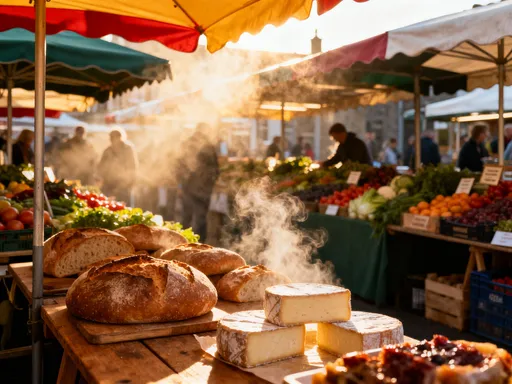
One of the most vivid first stops is Siab Bazaar, a sprawling marketplace that pulses with the city’s heartbeat. Rows of saffron, crimson dried peppers, and mountains of golden melons stretch beneath sun-bleached canopies. Vendors call out in Uzbek, Russian, and broken English, offering samples of warm flatbread or sweet halva wrapped in wax paper. The sensory richness is overwhelming in the best way—every color, smell, and sound pulls you deeper into the fabric of daily life. This is not a staged performance for tourists; it’s where families shop, neighbors catch up, and grandmothers haggle over the price of fresh herbs.
What strikes most newcomers is how quickly the pace of life recalibrates you. In Samarkand, time moves differently. People linger over tea. Conversations unfold slowly, without urgency. A simple exchange at a fruit stall might turn into a 10-minute chat about harvests, weather, or grandchildren. This unhurried rhythm is not inefficiency—it’s intentionality. It invites you to slow down, observe, and absorb. By the end of the first day, the constant mental checklist of must-see sights begins to soften, replaced by a quieter curiosity: not just what to see, but how to connect.
The Soul of the City: Why Cultural Immersion Beats Sightseeing
Most visitors come for the Registan—the breathtaking ensemble of madrasas adorned with intricate tilework that gleams under the Central Asian sun. And yes, it is magnificent. But the true soul of Samarkand lies beyond the postcard views. It lives in the moments when culture stops being something you observe and starts being something you experience. There’s a profound difference between walking through a historical site and being welcomed into a home, between photographing a ritual and being invited to share in it.
On my third evening, I wandered into a small neighborhood near Taq-i-Zargaron when I heard laughter and music. A family was celebrating a child’s birthday in their courtyard. Without hesitation, an elderly woman gestured for me to join, placing a plate of plov into my hands and pouring green tea from a curved teapot. No translator, no formalities—just warmth. That night, I didn’t just watch a celebration; I was part of it. Such spontaneous moments are not rare in Samarkand. Locals are often curious, kind, and genuinely pleased when a visitor shows interest in their way of life.
Cultural immersion means stepping off the path of curated tours and allowing yourself to be guided by curiosity and kindness. It means accepting an invitation to share bread, even if you don’t speak the language. It means sitting in silence with elders who smile but say little, yet whose presence speaks volumes. These interactions don’t come from guidebooks—they arise from openness and respect. And they transform travel from a series of sights into a collection of human connections. In Samarkand, you don’t just learn about history—you feel its continuity in the hands that break bread, the voices that sing old songs, and the eyes that welcome you as if you’ve always belonged.
Craftsmanship Alive: Hands-On Encounters with Traditional Artisans
One of the most moving aspects of Samarkand is how deeply tradition is woven into everyday work. Artisanship here is not a performance for tourists—it’s a living practice, passed from parent to child, guarded with pride. In quiet alleys behind the bustling bazaars, workshops hum with the sounds of creation. One such place is a small paper-making studio near the Afrasiab hills, where artisans still produce paper from mulberry bark, just as they did during the Timurid era over 600 years ago.
The process is mesmerizing. Strips of bark are boiled, beaten, and laid out on wooden frames to dry under the sun. The resulting sheets are strong, slightly textured, and warm in tone—perfect for calligraphy and miniature painting. I watched as a craftsman named Rahim demonstrated the technique, his hands moving with the ease of decades. When he handed me a frame to try, my clumsy attempt produced a lopsided sheet, but he laughed kindly and said, “First try is always a story.” That paper, imperfect as it was, became one of my most treasured souvenirs—not because of its beauty, but because of the connection it represented.
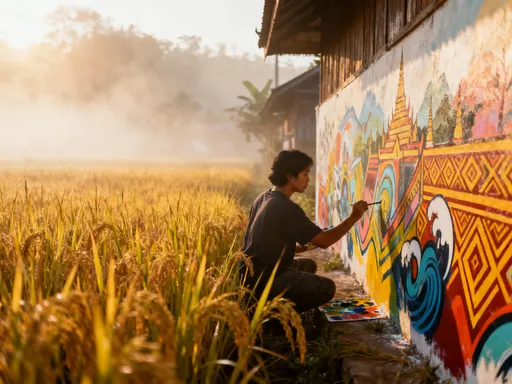
Another unforgettable experience was learning ceramic painting in a family-run workshop in the old quarter. The potter, Dilrabo, came from three generations of ceramists. Her hands moved swiftly over a porcelain plate, painting delicate blue-and-white floral patterns inspired by Persian and Chinese designs. She explained that each motif has meaning—vines for continuity, stars for guidance, birds for freedom. When I picked up a brush, my strokes were hesitant, but she guided me patiently. “Art is not about perfection,” she said. “It’s about intention.” By the end, I had painted a simple flower, crooked but sincere. That plate now hangs in my kitchen, a daily reminder of hands that preserve beauty across centuries.
What makes these encounters so powerful is the pride artisans take in their work. They are not performing for tourists; they are keeping a legacy alive. Many express concern that younger generations may not continue these crafts, but they remain committed to teaching anyone willing to learn. By participating—even clumsily—you become part of that preservation. You’re not just buying a souvenir; you’re honoring a tradition that has survived empires, wars, and time.
Sounds of the Past: Experiencing Traditional Music in Intimate Settings
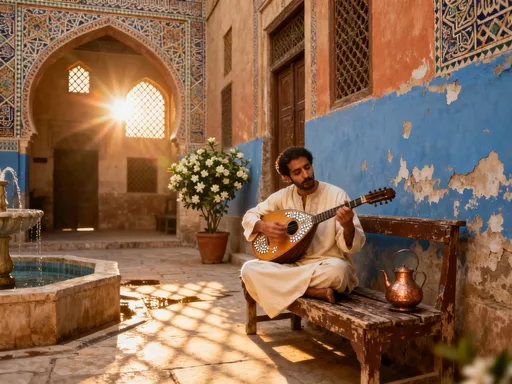
If craftsmanship is the hand of Samarkand’s culture, music is its voice. And nowhere is that voice more moving than in the quiet courtyards of its historic madrasas, where small groups of musicians gather in the evenings to perform shashmaqam—the classical music of Central Asia. Rooted in Persian and Sufi traditions, shashmaqam is not background noise; it is a spiritual practice, a form of storytelling that transcends language.
I first heard it by chance, drawn by the sound of a tanbur—a long-necked lute—drifting through the arches of Ulugh Beg Madrasa. A small circle of locals and a few travelers had gathered. There were no tickets, no announcements, just music unfolding under a canopy of stars. The lead singer’s voice rose and fell like a desert wind, carrying lyrics of love, loss, and divine longing. Even without understanding the words, the emotion was unmistakable. A woman beside me closed her eyes, her lips moving as if in prayer. A young man recorded the moment on his phone, not to post, but to remember.
What struck me most was the intimacy of the experience. There were no spotlights, no microphones, no stage. Just six musicians and an audience of perhaps twenty, connected by sound and silence. In that moment, music wasn’t entertainment—it was memory. Each note carried centuries of history, of caravans crossing deserts, of poets writing by candlelight, of families gathering after long days. The melodies felt familiar, not because I had heard them before, but because they touched something universal—the human need to express what words alone cannot.
Music in Samarkand is not confined to performances. It spills into homes, teahouses, and even quiet moments on the street. I once passed a tailor’s shop and heard a radio playing a traditional doira (frame drum) rhythm. The tailor, stitching a robe, tapped his foot in time. When he saw me smiling, he gestured to the beat and said, “This is how we stay alive.” In a world where so much culture feels digitized or diluted, Samarkand reminds us that music, when lived, is not just heard—it is felt in the bones.
Taste as a Gateway: Food That Tells a Story
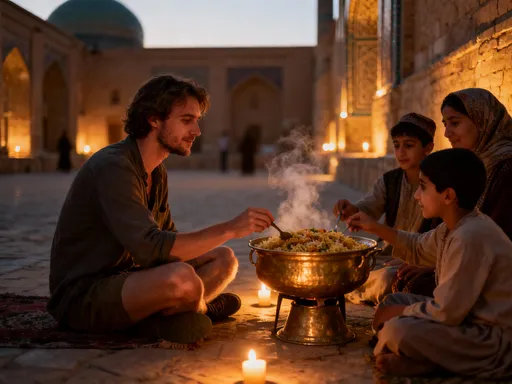
In Samarkand, every meal is an act of hospitality, a bridge between strangers. Food is not just sustenance; it is history served on a plate. Nowhere is this more evident than in plov, the national dish of Uzbekistan, which in Samarkand reaches a level of reverence. I had the honor of sharing plov in the home of a local woman named Nargiza, who cooked it in a kazan—a massive cauldron—over an open flame in her courtyard.
The process was ritualistic. First, she fried lamb in oil until golden, then added carrots, rice, and a blend of spices passed down through generations. As the kazan simmered, neighbors stopped by to greet her, each receiving a small taste. When it was finally ready, we sat on cushions around a dastarkhan—a traditional cloth spread with food—and ate with our hands, as is customary. The plov was rich, fragrant, and deeply satisfying, but what made it unforgettable was the act of sharing. No one rushed. No one looked at a phone. We ate, we talked, we laughed. When I complimented the meal, Nargiza simply said, “This is how my mother taught me. Now you know her too.”
Another daily ritual is tea. In Samarkand, green tea is not just a drink—it’s a symbol of welcome. Every home, shop, and teahouse offers it, always served in a small glass with a saucer, often with dried fruits or sweets on the side. I spent mornings at a local chaihana, where men played dominoes and debated the news, while women exchanged recipes. The tea was strong, slightly bitter, and always refilled. “Empty cup means empty heart,” my host once joked. Through tea, I learned about harvests, family, and the quiet joys of routine.
Each dish in Samarkand tells a story. Somsa, the flaky pastry filled with meat and onions, originated as portable food for travelers on the Silk Road. Shashlik, grilled meat skewers, were once cooked by nomads over open fires. Even simple bread—obey—carries meaning. Baked in clay ovens called tandoors, it is never placed upside down, as that is considered disrespectful. To eat in Samarkand is to be invited into a living narrative, where every bite connects you to centuries of tradition, resilience, and generosity.
Beyond the Guidebook: Navigating Samarkand Like a Local
To truly experience Samarkand, it helps to move like a local. Public minibuses, known as marshrutkas, are the most common way to get around. They’re inexpensive, frequent, and offer a real glimpse into daily life. Don’t expect assigned seats or digital tracking—just wave one down, hop in, and enjoy the ride. Most drivers are patient with tourists, and a simple phrase like “Registan, iltimos” (please) goes a long way.
Learning a few basic Uzbek phrases can also deepen your experience. While many younger people speak some English, older generations often do not. Simple greetings like “Salom” (hello) and “Rahmat” (thank you) are appreciated and often met with warm smiles. A willingness to try the language shows respect and opens doors. Even mispronunciations are greeted with kindness—locals understand the effort.
Timing matters, too. To avoid crowds at major sites like the Registan or Shah-i-Zinda, arrive early in the morning or later in the afternoon. Not only will you have better photo opportunities, but you’ll also witness the sites as locals do—quiet, reflective, and full of light. Early mornings are especially magical, when the golden domes glow in the sunrise and the air is still cool.
When engaging with locals, respect is key. Always ask before taking photos of people, especially elders or in religious settings. Dress modestly when visiting mosques or homes—shoulders and knees covered is a safe rule. And when invited into someone’s home, bring a small gift if possible, such as fruit, sweets, or tea. These gestures are not required, but they are meaningful.
Most importantly, travel with openness, not expectation. Samarkand rewards curiosity. Wander without a map sometimes. Sit in a park and watch children play. Accept an invitation even if you’re unsure where it leads. The most memorable moments are rarely planned—they arise from presence, patience, and a willingness to be surprised.
Why Samarkand Stays With You: The Lasting Impact of Authentic Exploration
Months after returning home, Samarkand remains vivid in my mind. Not just the monuments, but the quiet moments: an old man praying at Bibi-Khanym Mosque, hands raised in silent devotion; children chasing a ball through the alleyways near Shah-i-Zinda, their laughter echoing off ancient walls; a young girl offering me a bite of fresh melon at the bazaar, her eyes sparkling with pride.
These are the images that linger, not because they are dramatic, but because they are real. Samarkand has a way of recalibrating your sense of what travel can be. It moves you beyond checklists and photo ops toward something deeper—a sense of belonging, however brief. You begin to understand that culture is not something you consume, but something you participate in. And in that participation, you carry a piece of it with you.
The city also reshapes expectations. After Samarkand, other destinations may feel curated, distant, or overly commercial. You start to seek out places where life unfolds naturally, where traditions are lived, not performed. You value slow travel, human connection, and the beauty of imperfection. You realize that the most meaningful journeys are not about how far you go, but how deeply you see.
Samarkand does not demand attention through spectacle alone. It earns affection through authenticity. It reminds us that history is not dead—it breathes in the hands that shape clay, the voices that sing old songs, the tables that welcome strangers. To visit Samarkand is not just to witness a culture—it is to be gently invited into its ongoing story.
Conclusion
Samarkand doesn’t dazzle you once and fade away—it embeds itself in your memory. By stepping into its living culture, you don’t just see history; you become part of its continuation. This is travel at its most meaningful. It challenges you to look beyond the surface, to listen, to participate, and to remember that every destination has a heartbeat—if you take the time to feel it. For those willing to slow down and open their hearts, Samarkand offers not just a journey across geography, but across time. And in that crossing, you may find yourself changed, quietly and forever.