You Won’t Believe These Hidden Architectural Gems in Kazan
Kazan isn’t just another Russian city—it’s a visual feast. As I wandered through its streets, camera in hand, I was stunned by how East meets West in its architecture. From ancient minarets to futuristic domes, every corner tells a story. If you're into photography and love capturing unique urban landscapes, this city should be on your radar. What makes Kazan truly special? Let me take you on a journey through its most photogenic architectural wonders. With sunlight glinting off golden cupolas and shadows dancing across centuries-old stone, the city unfolds like a living museum where every district whispers a different chapter of history. This is not just a destination—it’s an invitation to see how cultures can coexist in harmony, expressed through brick, tile, and light.
The Soul of Two Worlds: Kazan’s Architectural Identity
Kazan’s skyline is a rare urban tapestry where Islamic and Orthodox influences stand side by side, not in conflict, but in quiet conversation. This duality is not accidental—it is rooted in centuries of shared history between the Tatar and Russian peoples, a coexistence that has shaped the city’s physical and cultural landscape. The Tatar presence, with its deep Islamic traditions, brings delicate arabesques, turquoise domes, and slender minarets into view, while Russian heritage contributes onion-shaped cupolas, bell towers, and symmetrical stone facades. Together, they create a cityscape that feels both familiar and exotic, where no single architectural style dominates but all contribute to a balanced whole.
Nowhere is this blend more evident than in the Old Tatar Settlement, a historic neighborhood nestled within the city’s modern core. Walking through its narrow lanes, one encounters wooden houses with carved eaves standing beside small mosques and family-run tea houses. The facades are often painted in warm earth tones—ochre, terracotta, and deep green—with latticework windows that filter sunlight into intricate patterns. These homes, many dating back to the 19th century, reflect a domestic architecture that values privacy, craftsmanship, and community. At the same time, broad avenues like Baumana Street showcase grander structures, where pre-Soviet merchant buildings with ornate stucco work stand shoulder to shoulder with Soviet-era administrative blocks, creating a layered timeline of urban development.
This architectural harmony is not merely aesthetic—it reflects a deeper social resilience. After periods of upheaval, including the destruction of much of the city’s Islamic heritage in the past, Kazan has rebuilt with intention, preserving memory while embracing renewal. Today, new constructions often incorporate traditional Tatar motifs—such as star-shaped window grilles or geometric tile inlays—into modern designs, ensuring that cultural identity remains visible in the city’s evolving form. For the observant traveler, especially one with a camera, this means every street corner offers a potential composition that speaks to continuity and adaptation.
Kremlin Walls and Golden Domes: Inside Kazan’s Heart
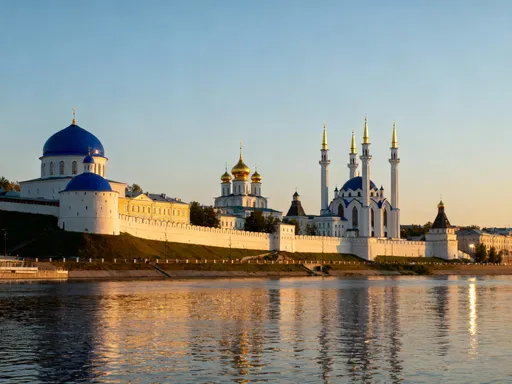
At the center of Kazan’s architectural narrative stands the Kazan Kremlin, a UNESCO World Heritage Site that encapsulates the city’s spiritual and historical depth. Enclosed within ancient white limestone walls, this fortified complex is home to some of Russia’s most significant religious structures, where faith and form converge in breathtaking symmetry. The most striking contrast lies between the Qolşärif Mosque and the Annunciation Cathedral, two houses of worship that face each other across a sunlit courtyard, embodying the peaceful coexistence of Islam and Orthodox Christianity.
The Qolşärif Mosque, completed in 2005, is a modern reconstruction of a mosque destroyed centuries ago during Ivan the Terrible’s conquest of Kazan. Its design, inspired by classical Tatar and Central Asian architecture, features four towering minarets reaching 58 meters high and a central dome painted in shimmering sky-blue with gold accents. The interior is equally impressive, with vast chandeliers, hand-painted floral motifs, and a quiet elegance that invites contemplation. From a photographic standpoint, the best vantage points are from the western ramparts of the Kremlin or the embankment across the Kazanka River, where the mosque’s reflection dances on the water at sunrise.
Directly opposite stands the Annunciation Cathedral, a 16th-century Russian Orthodox church built during the reign of Ivan IV. With its trio of green-and-gold onion domes and white stone façade, it presents a classic example of early Muscovite architecture. Inside, centuries-old icons and frescoes line the walls, their colors softened by time. Photographers will appreciate the interplay of light through its small arched windows, especially in the late afternoon when golden beams illuminate the iconostasis. To capture both landmarks in a single frame, the central courtyard of the Kremlin offers a balanced composition, particularly during early morning when few visitors are present and the air carries a soft stillness.
For optimal results, a wide-angle lens is recommended to encompass the full scale of these structures, while a telephoto can isolate architectural details such as the calligraphy on the mosque’s façade or the intricate carvings around the cathedral’s entrance. Given the site’s protected status, drone photography is not permitted within the Kremlin grounds, but handheld shots from elevated walkways provide ample creative opportunities. Visiting early in the day also allows for softer shadows and fewer crowds, enhancing both the visual clarity and emotional resonance of your images.
Beyond the Kremlin: Street-Level Architectural Surprises
While the Kremlin dominates postcard views, Kazan’s true architectural soul reveals itself in its neighborhoods beyond the fortress walls. Here, in districts like Tatarskaya Sloboda and the historic city center, one discovers a treasure trove of pre-revolutionary buildings, merchant mansions, and art nouveau facades that have survived decades of change. These structures, often overlooked by casual tourists, offer some of the most intimate and photogenic moments in the city, where texture, color, and human presence intertwine.
Along streets such as Dekabristov and Profsoyuznaya, rows of late 19th- and early 20th-century buildings display the elegance of Russian eclecticism—a style that freely borrowed from Gothic, Baroque, and Renaissance forms. Look for ornate cornices, wrought-iron balconies, and stained-glass transoms above doorways. Many of these homes once belonged to wealthy merchants who traded in textiles, grain, and leather, and their facades reflect both prosperity and artistic ambition. The use of contrasting materials—red brick paired with white stone trim, or stucco painted in deep maroon and cream—adds visual rhythm to the streetscape.
One particularly photogenic area is the intersection near the Temple of All Religions, a whimsical private project that blends Byzantine, Gothic, Islamic, and even Chinese architectural elements into a single, eclectic compound. Though not officially part of the city’s historic fabric, it serves as a visual metaphor for Kazan’s openness to diverse forms. Nearby, small courtyards open up like hidden pockets, revealing ivy-covered walls, carved wooden gates, and flower-filled planters that soften the stone and brick. These spaces are ideal for capturing intimate compositions—close-ups of weathered surfaces, peeling paint, or the play of shadow and light across a curved archway.
To make the most of these discoveries, slow down and explore on foot. A prime time for photography is mid-morning, when the sun slants across building facades, emphasizing depth and dimension. A polarizing filter can help reduce glare on glass and enhance sky contrast, while a 35mm or 50mm prime lens allows for sharp, natural-looking street scenes. Don’t hesitate to return to the same location at different times of day—many of these buildings take on a completely different character when illuminated by warm evening light or the cool glow of streetlamps after dark.
Modern Marvels: When Kazan Looks to the Future
While Kazan honors its past, it is also boldly stepping into the future with architectural projects that blend innovation with cultural respect. The city’s skyline now includes sleek, contemporary structures that do not overshadow tradition but instead engage in a dialogue with it. Among the most striking is the Islamic Center complex, anchored by a soaring 60-meter minaret that echoes the form of the Qolşärif Mosque but rendered in minimalist modern lines. The entire complex, completed in the 2010s, features clean geometric shapes, reflective glass surfaces, and expansive prayer halls designed to accommodate growing congregations without sacrificing aesthetic dignity.
Another landmark of modern Kazan is the Kazan Arena, a state-of-the-art sports complex built for the 2013 Summer Universiade and later used during the 2018 FIFA World Cup. Its futuristic design includes a dynamic, undulating roof that resembles a traditional Tatar headdress, known as a *kalfak*, when viewed from above. At night, the stadium comes alive with LED lighting that shifts in color and pattern, transforming it into a kinetic sculpture visible from miles away. For photographers, the best views are from the nearby embankment of the Kazanka River, especially during evening hours when the illuminated structure reflects on the water’s surface.
The city’s commitment to blending tradition and innovation extends to smaller public buildings as well. The Kazan Metro stations, for instance, are architectural highlights in their own right—each one uniquely designed with themes reflecting Tatar culture, from folk patterns to historical narratives etched into marble walls. The “Kremlyovskaya” station, located near the Kremlin, uses warm-toned stone and soft lighting to evoke a sense of underground grandeur, while “Gorki” station features bold geometric mosaics that nod to Soviet-era design with a modern twist.
For those interested in long-exposure or architectural night photography, several vantage points offer unobstructed views of these modern landmarks. The riverfront promenade near the Millennium Bridge provides a panoramic outlook, while elevated pedestrian walkways near the business district allow for elevated compositions. Drone use is permitted in certain public zones outside protected areas, but operators must register with local authorities and follow strict guidelines. Always check current regulations before flying, as restrictions can change based on events or security considerations.
Chasing Light: Best Times and Seasons for Architectural Photography
Like any great subject, Kazan’s architecture reveals its full character only when seen under the right light. The city’s visual magic shifts dramatically with the time of day and season, offering photographers a dynamic range of conditions to explore. The golden hours—shortly after sunrise and before sunset—are particularly transformative, when low-angle sunlight bathes stone facades in warm tones and casts long, dramatic shadows that emphasize texture and depth.
In summer, daylight stretches well into the evening, with sunset occurring as late as 9:30 PM. This extended twilight provides ample opportunity to capture the city in soft, diffused light. The embankments along the Kazanka River become prime spots, where reflections of mosques, churches, and modern towers shimmer on the water’s surface. Morning light, especially between 6:00 and 7:30 AM, is ideal for photographing the Kremlin, as the rising sun illuminates the eastern walls while the western structures remain in gentle shadow, creating a balanced exposure.
Winter, though colder, offers its own photographic rewards. Snow-covered streets mute colors but enhance form, turning buildings into sculptural silhouettes against a pale sky. The reflective quality of snow amplifies ambient light, softening contrasts and creating a naturally diffused glow. On clear winter days, the sun, though low in the sky, produces crisp shadows that define architectural lines with precision. The same landmarks that appear vibrant in summer take on a serene, almost ethereal quality when dusted with snow—especially the blue domes of the Qolşärif Mosque, which stand out vividly against a monochrome backdrop.
Spring and autumn bring transitional palettes—blossoms in April and May add soft pinks and whites to courtyard compositions, while October’s golden foliage frames buildings in warm hues. Overcast days, often dismissed by photographers, can actually be advantageous for architectural work, eliminating harsh highlights and allowing for even tonal distribution across large façades. A neutral density filter can help manage exposure in bright conditions, while a tripod ensures sharpness in lower-light scenarios. Ultimately, the key is to visit the same location multiple times—each season, each hour, reveals a new facet of Kazan’s architectural soul.
Local Perspectives: Capturing Architecture with People in Frame
Architecture does not exist in isolation—it is lived in, passed through, and shaped by the people who inhabit it. Including locals in your photographs adds narrative depth, scale, and warmth, transforming static structures into dynamic scenes of everyday life. In Kazan, where public spaces are deeply integrated into the urban fabric, opportunities abound to capture authentic moments that enrich your visual story.
Along Baumana Street, a pedestrian-only avenue lined with historic buildings, vendors sell honey, herbal teas, and handcrafted Tatar jewelry from small kiosks. Elders sit on benches outside the Annunciation Cathedral, chatting or reading newspapers, while children chase pigeons near fountains. Near the university district, students in casual attire walk between lectures, their backpacks and laughter adding movement to otherwise still façades. These interactions humanize the architecture, reminding viewers that these buildings are not museum pieces but active parts of daily life.
When photographing people, respect is paramount. In Kazan, most locals are accustomed to visitors and generally open to being photographed, especially in public spaces. However, it is always courteous to smile, make eye contact, and, when possible, ask permission—particularly when focusing on individuals or small groups. Candid shots work best when taken from a slight distance, using a medium telephoto lens (70–100mm) to maintain natural expressions without intrusion. Avoid using flash in low-light indoor settings such as mosques or churches, as it can be disruptive and is often prohibited.
Consider framing your shots to include people as part of the environment rather than the sole subject. A woman in a colorful headscarf walking past the arched entrance of a merchant house, or a couple pausing to read a plaque on a historic wall, can add scale and emotional resonance. These moments tell stories not just about buildings, but about continuity, community, and cultural pride. Over time, your photo collection will reflect not only Kazan’s architectural diversity but also its living spirit.
Practical Tips for Photographers: Gear, Permits, and Navigation
Successfully photographing Kazan’s architectural riches requires more than just a good eye—it demands preparation. The city is compact and walkable, but knowing how to navigate it efficiently and respectfully will enhance both your experience and your results. Public transportation, including buses, trams, and the metro, is reliable and affordable, with key stops located near major landmarks. The “Kremlyovskaya” metro station provides direct access to the Kremlin, while the “Sukonnaya Sloboda” station is close to many historic merchant districts.
In terms of gear, a versatile zoom lens (24–70mm) is ideal for capturing both wide exteriors and tighter details. A wide-angle lens (16–35mm) is essential for fitting entire façades into the frame, especially in narrow streets, while a tripod can be invaluable for long exposures at dusk or dawn. However, be aware that tripods are sometimes restricted in crowded areas or inside religious sites—always check signage or ask staff before setting up. A lightweight backpack with padding will help protect your equipment during long walks.
Photography permits are generally not required for personal, non-commercial use in public spaces. However, professional shoots, especially those involving models, lighting, or drones, may require official authorization from city authorities. Drones are allowed in certain open areas but are prohibited near airports, government buildings, and within the Kremlin walls. Always verify current regulations through official tourism websites or local visitor centers.
For first-time visitors, joining a free walking tour is an excellent way to orient yourself. These tours, often led by knowledgeable locals, begin at central points like the Kazan Family Monument or the Musa Jalil Theatre and cover major architectural highlights while sharing historical context. Many guides are happy to recommend lesser-known photo spots, such as quiet courtyards or rooftop cafes with panoramic views. Carrying a simple phrasebook or translation app can also help when asking for directions or clarifying local rules.
Conclusion
Kazan’s architecture is more than stone and steel—it’s a living dialogue between centuries and cultures. For photographers, it offers rare depth and diversity within a compact urban space. Whether drawn by history, design, or pure visual drama, your lens will find endless reasons to keep clicking. The city doesn’t just invite observation; it demands it. From the golden domes of the Annunciation Cathedral to the sleek curves of the Kazan Arena, from snow-dusted minarets to sunlit merchant houses, every structure tells a story of resilience, identity, and beauty. As light shifts across its facades and locals move through its streets, Kazan reveals itself not as a static monument, but as a vibrant, evolving portrait of cultural harmony. For those willing to look closely, this city offers not just images, but meaning—one frame at a time.