You Won't Believe These Photo Spots in Te Anau's Hidden Corners
Te Anau isn’t just a gateway to Fiordland—it’s a photographer’s dream hiding in plain sight. I wandered its quiet streets and waterfront at golden hour, and honestly? The reflections off Lake Te Anau stopped me cold. This small lakeside town has pockets of magic you’d miss if you weren’t looking closely. From misty marinas to backroad lookouts, the real beauty lives in its everyday moments—no filter needed. Whether you’re chasing perfect symmetry in still waters or the soft glow of sunrise on weatherboard cottages, Te Anau offers a quietly powerful visual language. It’s a place where nature and community coexist, where every corner tells a story, and where the simplest scenes can become timeless images. This is not just a stopover—it’s a destination worth framing.
The Heartbeat of Te Anau: Town Centre Through the Lens
The town centre of Te Anau, though compact, pulses with photographic energy. Nestled between the vast expanse of Lake Te Anau and the surrounding alpine ridges, this modest hub is where architecture and atmosphere converge. The low-rise buildings, constructed with warm timber and stone, echo the natural palette of Fiordland. Their sloped roofs and wide eaves are designed to withstand the region’s frequent rainfall, but they also create strong geometric lines that draw the eye. Early morning light, especially in autumn and winter, casts long shadows across the sidewalks, highlighting textures in brickwork and wooden cladding. As the sun climbs, the interplay of light and shadow shifts, offering fresh compositions every hour.
One of the most rewarding times to photograph the town centre is during the golden hour just after sunrise or before sunset. At these times, the low-angle sunlight bathes the buildings in a soft, golden glow, enhancing the natural warmth of the materials. The sky often transforms into gradients of pink, orange, and lavender, reflecting subtly in shop windows and polished surfaces. Street-level details become especially compelling: a barista steaming milk behind a café window, the crisp lines of an awning casting a shadow on the pavement, or a bicycle leaning against a lamppost. These small moments, often overlooked, are the quiet heartbeats of the town.
Weather plays a transformative role in how the town centre appears through the lens. On overcast days, the diffused light eliminates harsh contrasts, making it ideal for capturing even exposures without blown-out highlights. Rain brings its own aesthetic charm—puddles form perfect mirrors, doubling the scene and adding depth. A light drizzle can soften edges and add a dreamlike quality to images. Conversely, on clear days, the contrast between the bright sky and shaded alleys can be challenging, but with careful exposure balancing, photographers can use this to their advantage, creating dramatic silhouettes or emphasizing architectural form.
Another layer of visual interest comes from the rhythm of daily life. Mornings are often bustling, with tourists picking up maps, locals grabbing coffee, and tour buses arriving for day trips to Milford Sound. By late afternoon, the pace slows. The foot traffic thins, and a sense of calm settles over the streets. This transition offers two distinct moods for storytelling: one of energy and anticipation, the other of stillness and reflection. Capturing both within a single visit allows for a richer narrative, showing Te Anau not just as a scenic backdrop but as a living, breathing community.
Lakefront Magic: Capturing Reflections on Te Anau’s Water’s Edge
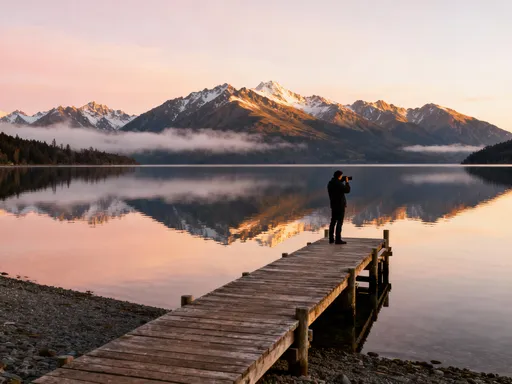
The lakeshore promenade is perhaps Te Anau’s most iconic photographic zone. Stretching along the edge of Lake Te Anau, this gently curving path offers uninterrupted views of the water and the distant mountains. But its true magic lies in its reflective surface. On calm mornings, especially in late spring and early summer, the lake becomes a flawless mirror, doubling the sky, the trees, and the surrounding peaks. This natural phenomenon allows photographers to create symmetrical compositions that are both striking and serene. The reflection of the Kepler Range across the water can appear so sharp that it’s hard to tell where the real landscape ends and the mirrored image begins.
To make the most of this setting, timing is essential. Dawn is often the best window for capturing still water. During these early hours, wind speeds are typically lowest, and human activity is minimal. Arriving before sunrise allows photographers to witness the gradual unveiling of the landscape as light spreads across the water. The first rays of sun often hit the mountain tops first, painting them in alpenglow before the valley below warms. This creates a gradient of color that can be captured in both wide-angle and telephoto shots.
Compositional techniques can elevate lakefront photography from simple snapshots to compelling imagery. One effective method is to use jetties and piers as leading lines. These wooden structures extend into the water, guiding the viewer’s eye toward the horizon or a distant peak. When the water is calm, their reflection creates a perfect vertical symmetry, doubling their visual impact. Including a lone figure walking along a pier can add scale and narrative, suggesting solitude and contemplation. Framing the scene with overhanging branches or native flax plants along the shore can also add depth and context.
Seasonal changes influence the lake’s appearance significantly. In spring, water levels are often higher due to snowmelt, which can submerge parts of the shoreline and create new reflective pools. Autumn brings golden hues from native beech trees, their colors mirrored in the water for a rich, warm palette. Winter introduces frost and occasional ice along the edges, adding texture and contrast. Even in summer, when afternoon breezes may ripple the surface, photographers can use slower shutter speeds to blur the water into a soft, ethereal wash, turning movement into mood.
Fiordland National Park Access Point: When the Wild Begins at Your Doorstep
Te Anau’s identity is deeply intertwined with Fiordland National Park, a UNESCO World Heritage site and one of New Zealand’s most treasured wilderness areas. As the primary gateway to Milford Sound and Doubtful Sound, the town serves as a launchpad for adventure, and this role is evident in its visual character. Photographers can capture the anticipation of exploration in the faces of trampers adjusting their packs outside outdoor gear shops, or in the quiet determination of kayakers preparing their vessels at the boat ramp. These moments, though fleeting, add a documentary dimension to any visual story of Te Anau.
The presence of the national park shapes the town’s aesthetic in subtle but meaningful ways. Signage featuring native birds like the kea or the tũiũi (mohua) appears on information boards, shop windows, and public art. These symbols connect the urban space to the natural world just beyond. Outdoor retailers display racks of waterproof jackets, hiking boots, and navigation tools, their windows becoming unintentional still-life compositions. Even the architecture often incorporates natural materials and earth tones, reinforcing the connection to the surrounding environment.
One of the most photogenic times to explore this theme is at dusk, when guided tours return from day hikes or boat excursions. The parking areas near the visitor centre come alive with activity—people unloading gear, sharing stories, and pausing to admire the evening light on the mountains. These candid moments reveal the emotional resonance of the Fiordland experience. A wide-angle shot of a group standing in silence, looking out over the lake, can convey awe and reflection. Close-ups of muddy boots, rain-slicked jackets, or a well-worn trail map tell stories of effort and discovery.
For photographers interested in environmental storytelling, the juxtaposition of human preparation and natural grandeur offers rich material. A single backpack resting against a bench, with the vast lake and mountains in the background, speaks to scale and solitude. A child peering into a display case of native insects at the Fiordland Conservancy Centre captures curiosity and education. These images, while grounded in everyday scenes, contribute to a larger narrative about conservation, adventure, and the human relationship with wild places.
The Marina District: Quiet Boats and Mountain Backdrops
Just south of the main town centre, the marina district offers a quieter, more contemplative photographic experience. Wooden docks stretch into the lake, lined with moored fishing boats, kayaks, and small cruisers. Unlike busier harbours, Te Anau’s marina retains a sense of intimacy and function. There are no flashy yachts or commercial terminals—just practical vessels used by locals for fishing, recreation, and transport. This authenticity makes the area ideal for capturing unposed, genuine moments.
The visual appeal of the marina lies in its balance of stillness and subtle motion. The boats, gently bobbing on the water, create ripples that distort reflections in pleasing ways. Seagulls often perch on mooring posts, adding life to otherwise static scenes. Early morning fog is common, especially in autumn, and it can wrap the marina in a soft, diffused light that blurs edges and enhances mood. A single shaft of sunlight breaking through the mist to illuminate a boat’s cabin window can become the focal point of a powerful image.
Photographers can experiment with different lenses to capture varied perspectives. A telephoto lens compresses the scene, bringing the distant snow-capped peaks into tighter proximity with the boats, creating a layered composition. A wide-angle lens, used at water level, can emphasize the leading lines of the docks while including expansive sky and mountain reflections. Including human elements, such as a fisherman untangling a net or a couple walking hand-in-hand along the dock, adds narrative depth without disrupting the tranquility.
Rain and overcast conditions, often seen as obstacles, can actually enhance the marina’s atmosphere. The darkened water absorbs light, creating a moody canvas for brighter elements like red boat hulls or yellow life jackets. Raindrops on the surface add texture, and a well-placed polarizing filter can reduce glare while deepening colors. For those willing to brave the elements, these conditions offer some of the most evocative opportunities in Te Anau.
Residential Zones: Where Locals Live and Light Dances Differently
Beyond the tourist-facing areas, Te Anau’s residential streets reveal a different kind of beauty—one rooted in daily life and seasonal rhythm. These quiet lanes, lined with weatherboard homes, native shrubs, and well-kept gardens, offer intimate photographic moments that are often missed by visitors. The houses, many painted in soft pastels or natural wood tones, blend harmoniously with the landscape. Hillside properties provide elevated views of the lake, and their windows often catch the first light of dawn, glowing like lanterns in the morning mist.
Sunrise is particularly magical in these neighborhoods. As the sun rises behind the town, it illuminates the eastern-facing walls of homes, creating warm highlights against cool shadows. Steam sometimes rises from rooftops after a cold night, adding a touch of ethereal detail. Native plants like flax, cabbage trees, and coprosmas grow in abundance, their textures and forms offering excellent foreground elements. A close-up of dew on a spiderweb in a garden hedge can be as compelling as a panoramic mountain view.
These areas also reflect the community’s connection to nature. Many homes feature solar panels, rainwater tanks, and wood piles—subtle indicators of sustainable living in a remote region. Children’s bicycles in driveways, bird feeders in trees, and hand-painted signs for homegrown produce add layers of authenticity. Photographing these details requires patience and respect for privacy, but when done thoughtfully, they contribute to a nuanced portrait of small-town life.
Because these streets are less frequented by tourists, they offer a sense of discovery. A winding road that disappears into the bush, framed by overhanging branches, invites exploration. A mailbox at the end of a gravel driveway, with mountains in the distance, can become a symbol of remoteness and simplicity. These are the quiet corners where photography becomes personal, where the act of seeing transforms the ordinary into the meaningful.
Edge of Town: Transitioning from Urban to Untamed
Where the paved roads meet the wilderness, Te Anau reveals its most poetic contrasts. The outskirts of town are where human settlement gently gives way to native bush, rolling farmland, and alpine terrain. This transitional zone is rich with photographic potential, offering compositions that blend the man-made with the natural. A simple wooden fence, weathered by wind and rain, can serve as a foreground element that leads the eye toward a distant peak. A lone tree standing in a pasture, silhouetted against a stormy sky, tells a story of resilience.
One effective technique in these areas is the use of long lenses to compress space. By zooming in on a distant mountain range while including a nearby gate or signpost in the frame, photographers can create a sense of layered depth. The result is an image that feels both expansive and intimate. These shots often work best in the late afternoon, when the low sun casts long shadows across the land, emphasizing texture in the grass, soil, and rock.
The changing seasons are especially visible at the town’s edges. In spring, paddocks turn vivid green, and lambs can be seen grazing near farmhouses. Autumn brings golden grasses and a soft haze that softens the mountains. Winter frosts dust the fields, and occasional snow caps the highest peaks. Summer introduces long daylight hours, allowing for extended shooting times and the possibility of capturing the Milky Way above a rural homestead.
These liminal spaces also reflect the coexistence of agriculture and conservation. Sheep farms border protected forest reserves, and walking trails begin just beyond backyard fences. A photograph of a “No Motor Vehicles” sign beside a tramping track, with a backpacker in the distance, underscores the town’s role as a steward of wilderness. These images, while quiet, carry a deeper message about balance, preservation, and the quiet rhythm of life at the edge of one of the world’s last great wild places.
Weather & Light: The Invisible District Shaping Every Shot
In Te Anau, weather is not just a condition—it’s a creative partner. The Southern Alps create fast-moving weather systems that can shift from bright sunshine to driving rain in minutes. While this unpredictability can challenge photographers, it also generates some of the most dynamic and dramatic lighting conditions. Storm clouds rolling in from the west often produce intense contrasts, with shafts of light breaking through to illuminate a single hillside or stretch of water. These fleeting moments, though brief, can yield extraordinary images.
Golden hour in Te Anau behaves differently than in more temperate regions. Due to the high latitude and mountainous terrain, the sun rises and sets at a low angle for much of the year, extending the duration of soft, directional light. However, cloud cover can diffuse this light, creating a broad, even illumination that minimizes harsh shadows. Understanding these nuances allows photographers to adapt quickly. A polarizing filter can enhance sky contrast on partly cloudy days, while a neutral density filter enables longer exposures during bright periods, smoothing water movement.
Chasing storms can be rewarding, but safety is paramount. Sudden downpours and high winds are common, especially near the lake, where open spaces offer little shelter. Carrying a waterproof cover for your camera is as essential as having extra batteries. Many of the most atmospheric shots—fog-draped marinas, rain-streaked windows, misty mountain ridges—are made possible only by being prepared for the elements. Patience is equally important; sometimes the best light arrives just as a storm clears, when the air is clean and the colors are most vivid.
Ultimately, success in Te Anau depends less on having the latest gear and more on adaptability. A simple point-and-shoot camera can produce stunning results in the right light. What matters most is presence—being there, observing, and responding to the moment. The town rewards those who slow down, who return to the same spot at different times, who embrace change rather than resist it. In this way, photography in Te Anau becomes not just about capturing images, but about deepening one’s connection to place.
Te Anau’s districts may seem small, but together they form a layered canvas for storytelling through photography. It’s not just about grand vistas—it’s the quiet corners, changing skies, and local rhythms that give this town its visual soul. Pack your camera, slow down, and let the real magic reveal itself—one frame at a time.