This Is Why Chiang Rai’s Art Spaces Are Pure Magic
You know that feeling when you stumble upon a place so surreal, you have to pinch yourself? That’s Chiang Rai. Far beyond typical Thai tourism, this northern gem hides jaw-dropping art spaces where creativity runs wild. From temples that defy imagination to open-air galleries nestled in nature, every corner feels like a scene from a dream. I went searching for inspiration — and found soul-stirring beauty instead. This is not just a destination for the eyes, but for the spirit. Chiang Rai invites you to slow down, look closely, and feel deeply. It’s where art isn’t displayed — it lives, breathes, and transforms.
The Soul of Northern Thailand: Chiang Rai’s Artistic Pulse
Chiang Rai, nestled in the mountainous folds of northern Thailand, pulses with a quiet creative energy that sets it apart from the bustling beaches and urban rhythms of the country’s more familiar destinations. While cities like Bangkok and Phuket draw millions with their modern conveniences and tropical appeal, Chiang Rai offers something rarer: authenticity woven into art. The city’s cool air, mist-laced mornings, and emerald-green hills create a serene backdrop, one that seems to invite introspection and expression in equal measure. Here, art is not confined to galleries or reserved for special occasions — it spills onto temple walls, village alleys, and forest clearings, becoming part of daily life.
This artistic pulse is deeply rooted in Lanna culture, the historical heritage of northern Thailand that emphasizes craftsmanship, storytelling, and spiritual symbolism. Traditional motifs — swirling nāga serpents, tiered temple roofs, and intricate wood carvings — are not relics of the past but living elements reinterpreted by contemporary artists. Chiang Rai has become a sanctuary for those who wish to honor tradition while pushing boundaries. Local schools, community centers, and independent studios nurture young talent, ensuring that creativity is not just celebrated but sustained across generations. The result is a cultural landscape where ancient wisdom and modern vision coexist in harmony.
What makes Chiang Rai especially compelling is its resistance to commercialization. Unlike other tourist hubs that cater primarily to mass appeal, this city maintains a sense of intimacy and intentionality. Visitors often remark on the unhurried pace, the warmth of local interactions, and the absence of aggressive sales tactics. This atmosphere allows space for genuine connection — between traveler and place, observer and artwork, self and surroundings. In Chiang Rai, art is not a performance for outsiders; it is a reflection of inner truths, shared with humility and pride.
Wat Rong Khun (The White Temple): Where Vision Meets Art
No discussion of Chiang Rai’s art scene is complete without mentioning Wat Rong Khun, the dazzling White Temple that has become a global icon. Designed and funded by Thai contemporary artist Chalermchai Kositpipat, this temple is unlike any other in Thailand — or the world. From a distance, it appears almost otherworldly: a gleaming structure of white plaster and mirrored glass shards, shimmering under the northern sun like a palace forged from light. Every surface is meticulously detailed, from the celestial figures adorning the bridge of rebirth to the ghostly hands reaching upward from the earth, symbolizing human desire and suffering.
What many tourists don’t realize is that Wat Rong Khun is not a traditional temple in the religious sense. It is, first and foremost, a work of art — a spiritual manifesto in physical form. Chalermchai began construction in 1997 with his own funds, envisioning a space that would reflect Buddhist teachings through a modern lens. The temple’s pristine white color represents purity of mind, while the embedded mirror pieces signify the wisdom and brilliance of the Buddha. The journey across the bridge, flanked by depictions of heaven and hell, is meant to be a meditative experience — a visual parable of karma, enlightenment, and the human condition.
Despite its popularity, the temple remains a work in progress, with new structures and symbolic elements still being added. Chalermchai has stated that completion may take decades, perhaps even beyond his lifetime. This ongoing evolution reflects a deeper truth: that art, like spiritual growth, is never truly finished. Visitors are encouraged to walk slowly, observe thoughtfully, and engage with the symbolism rather than rush for photographs. While the temple has undeniably become an Instagram sensation, its true power lies in its ability to provoke reflection, humility, and a sense of awe that lingers long after departure.
Ban Din Chan: A Hidden Mural Village Awakening
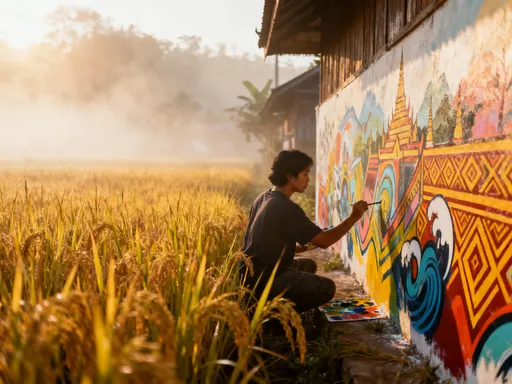
Just a short drive from Chiang Rai’s city center lies Ban Din Chan, a quiet rural village that has quietly transformed into an open-air gallery of profound emotional resonance. Once overlooked and economically stagnant, this community found new life through the power of street art. In recent years, local artists, supported by regional cultural initiatives and volunteer collectives, began painting large-scale murals on the blank walls of homes, schools, and rice barns. What emerged was not mere decoration, but a visual narrative of village life — its joys, struggles, memories, and dreams.
The murals depict everyday scenes: farmers tending fields at dawn, children playing with kites, elders sharing stories under shaded trees. Some panels portray historical moments, such as the arrival of the first schoolteacher or the construction of the village’s first bridge. Others capture fleeting, poetic moments — a mother braiding her daughter’s hair, a fisherman casting a net at sunset. Each image is rendered with care and authenticity, using soft natural tones and expressive brushwork that convey both dignity and tenderness. These are not idealized fantasies, but honest portrayals of a life lived close to the land.
The impact of this artistic revival has been transformative. Locals report a renewed sense of pride and unity, with younger generations expressing greater interest in preserving their heritage. Tourism has increased modestly, bringing visitors who come not for spectacle, but for connection. Families now gather near certain murals to take photos, not because they are flashy, but because they recognize their own stories within the paint. Art, in this context, becomes a mirror — reflecting identity, affirming value, and strengthening community bonds. Ban Din Chan stands as a powerful reminder that beauty does not require grandeur; sometimes, it is found in the quiet dignity of ordinary life.
Baan Dam (The Black House): Darkness, Depth, and Genius
If Wat Rong Khun represents the light, Baan Dam — often called The Black House — embodies the shadow. Created by Thailand’s celebrated artist Thawan Duchanee, this sprawling complex of over 40 dark wooden structures is a profound counterpoint to conventional ideas of sacred or aesthetic space. Unlike a museum or temple, Baan Dam was never intended as a public attraction. It was, for Thawan, a personal journey — a physical manifestation of his exploration into the primal forces of existence: life, death, desire, and transcendence.
The architecture blends traditional Lanna craftsmanship with bold, symbolic forms. Steep black roofs, angular pavilions, and animal skulls embedded in walls create an atmosphere both ancient and unsettling. Inside, visitors encounter collections of tribal artifacts, antique weapons, buffalo horns, and ceremonial objects arranged with deliberate intensity. The absence of bright colors and open spaces evokes a sense of introspection, even solemnity. Yet, far from being morbid, the space invites contemplation. Thawan, a devout Buddhist, saw darkness not as evil, but as a necessary counterpart to light — a space where the soul confronts its deepest truths.
Misunderstandings about Baan Dam are common. Some visitors expect a horror-themed attraction or misinterpret its symbolism as macabre. In reality, the complex is deeply philosophical, rooted in Buddhist and animist worldviews. It challenges the Western tendency to equate beauty with brightness and comfort. Here, beauty is found in rawness, in the acceptance of impermanence, in the courage to face what lies beneath the surface. Thawan’s legacy lives on through the careful preservation of his vision, and Baan Dam continues to inspire those willing to look beyond appearances and engage with art as a form of spiritual inquiry.
Art on the Edge: Experimental Spaces Beyond the Mainstream
While Wat Rong Khun and Baan Dam dominate headlines, Chiang Rai’s true artistic vitality lies in its grassroots, experimental spaces. COCA (Chiang Rai Contemporary Art Center) is one such hub, functioning as both gallery and creative incubator. Housed in a converted warehouse, COCA hosts rotating exhibitions by emerging Thai and international artists, often exploring themes of identity, environment, and cultural memory. The space also offers workshops, artist residencies, and community outreach programs, ensuring that art remains accessible and participatory.
Beyond formal institutions, pop-up installations and seasonal festivals animate the city throughout the year. During the Chiang Rai Art Festival, vacant lots, riverbanks, and temple courtyards become temporary canvases for performance art, sculpture, and interactive exhibits. Local universities and art schools contribute installations that blend traditional materials with modern concepts — bamboo structures that double as sound sculptures, rice paper lanterns embedded with poetry, or textile works that map village histories. These events are not polished spectacles, but living experiments — raw, evolving, and deeply connected to place.
What unites these spaces is their commitment to inclusivity. Unlike elite art scenes that cater to collectors and critics, Chiang Rai’s experimental art thrives on community involvement. Residents are invited to contribute ideas, volunteer, or simply wander through and engage. Children sketch installations, elders share stories with artists, and visitors are often encouraged to leave their mark — a written wish, a painted tile, a folded paper crane. This democratic approach ensures that art is not something to be passively consumed, but actively co-created. In doing so, Chiang Rai redefines what it means for a city to be culturally alive.
Why These Spaces Are Instagram-Worthy (But So Much More)
There’s no denying that Chiang Rai’s art spaces are visually stunning — perfectly composed for social media. The White Temple’s mirrored brilliance, the Black House’s dramatic silhouettes, the vibrant murals of Ban Din Chan — each offers a frame-worthy moment. Travel influencers and photographers flock here, drawn by the contrast, scale, and surreal beauty. Hashtags like #WhiteTemple and #ChiangRaiArt have millions of views, fueling the city’s global visibility.
Yet, reducing these spaces to backdrops for photos does them a disservice. Their true significance lies in their depth — the stories they tell, the emotions they evoke, the questions they raise. A photo of Wat Rong Khun may capture its dazzling exterior, but it cannot convey the silence that falls as you cross the bridge, or the weight of the hands rising from the ground beneath your feet. A snapshot of a Ban Din Chan mural shows color and composition, but not the laughter of the child depicted, now grown, pointing at her younger self for visiting relatives.
Chiang Rai’s art invites a slower kind of engagement — one that begins with wonder but deepens into understanding. It asks viewers to look beyond aesthetics and consider context: Who made this? Why? What does it mean to the people who live here? This shift — from consumption to connection — is where transformation begins. When art is approached with respect and curiosity, it becomes more than decoration; it becomes dialogue. And in a world increasingly dominated by fleeting digital impressions, Chiang Rai offers something rare: art that stays with you, not because you saw it, but because you felt it.
How to Experience Chiang Rai’s Art Scene Like a Local
To truly appreciate Chiang Rai’s art, one must adopt the rhythm of the place — slow, observant, and open-hearted. The best time to visit is during the cool season, from November to February, when the air is crisp and the skies clear, enhancing both visibility and comfort. Mornings are ideal for temple visits, as light bathes Wat Rong Khun in a soft glow and crowds are thinner. For Baan Dam, late afternoon offers a more contemplative atmosphere, with long shadows deepening the space’s introspective mood.
Transportation in Chiang Rai is flexible but best approached with patience. While rental cars and taxis are available, many visitors find that hiring a local driver for a day provides not only convenience but insight. These drivers often share personal stories, recommend hidden spots, and help navigate unpaved roads to villages like Ban Din Chan. For the more adventurous, bicycle tours around the outskirts combine art viewing with nature immersion, passing through rice fields, orchards, and hillside trails.
Etiquette is essential, especially at sacred or culturally significant sites. Visitors should dress modestly — shoulders and knees covered — when entering temples or community spaces. Shoes must be removed before stepping onto elevated platforms or into exhibition halls. Photography is generally permitted, but flash and tripods may be restricted in indoor areas. Most importantly, engage with respect. Ask before photographing people, speak softly in quiet spaces, and support local artists by purchasing authentic crafts directly from studios or markets.
For a deeper experience, consider staying in a family-run guesthouse or homestay. These accommodations offer more than lodging — they provide connection. Hosts often share home-cooked meals, introduce guests to neighbors, and offer invitations to local events. Combine art visits with nature excursions: hike in Doi Tung, visit the Royal Park, or take a quiet boat ride along the Mae Kok River. Let the journey unfold organically, allowing space for unexpected discoveries — a roadside sculpture, a village festival, a conversation with an artist painting in the shade. In Chiang Rai, the best moments are rarely planned.
Conclusion: Art That Changes How You See Thailand
Chiang Rai does not simply offer art — it redefines what art can be. It is not confined to frames or pedestals, nor is it created solely for admiration. Here, art is a living force — spiritual, communal, and deeply human. It emerges from tradition yet dares to question, draws crowds yet speaks to the individual, dazzles the eye yet stirs the soul. In a country often associated with beaches and temples, Chiang Rai reveals another dimension of Thailand: one of bold creativity, quiet resilience, and profound emotional depth.
The White Temple, the Black House, the murals of Ban Din Chan, the experimental galleries — these are not just attractions. They are invitations. To pause. To reflect. To see beauty in contrast, meaning in complexity, and connection in shared expression. They remind us that travel is not only about where we go, but how we see. When approached with openness and respect, Chiang Rai’s art spaces become mirrors — reflecting not just Thai culture, but our own capacity for wonder, empathy, and transformation.
For the thoughtful traveler — especially those seeking more than surface-level experiences — Chiang Rai offers a rare gift: depth. It asks us to look beyond the postcard, to listen to stories whispered in paint and wood, to honor context, and to let art lead the way. In doing so, it doesn’t just change how we see Thailand. It changes how we see ourselves.